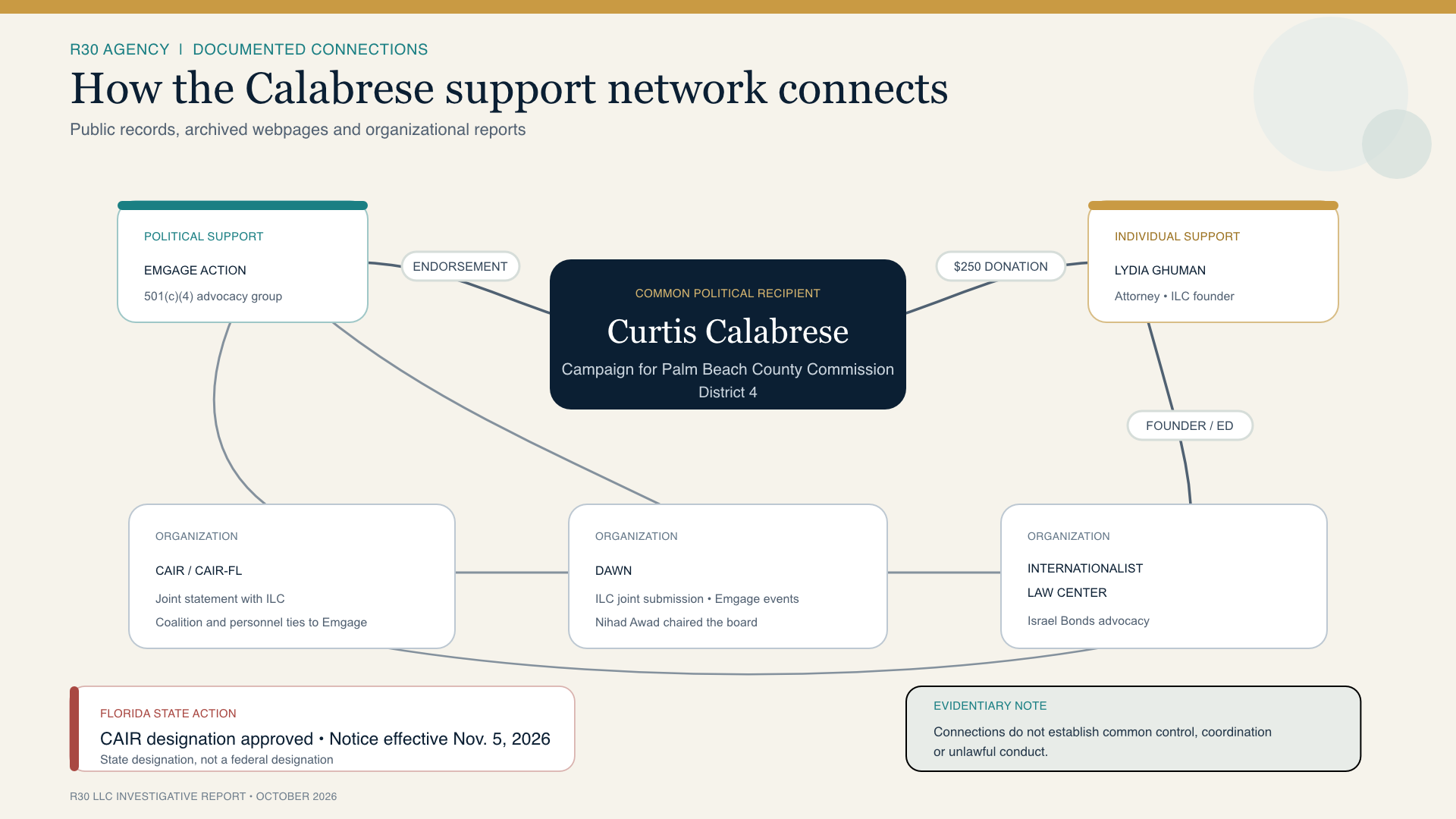
Public records and archived webpages connect Curtis Calabrese’s campaign to Emgage Action and Internationalist Law Center founder Lydia Ghuman, whose organizational relationships extend to CAIR, DAWN and related advocacy initiatives.
Florida officials have approved state-law terrorist designations for the Council on American-Islamic Relations, the Muslim Brotherhood and Antifa. Gov. Ron DeSantis and the Florida Cabinet approved the designations on Sept. 29, 2026, under Section 943.03102, Florida Statutes. The Florida Department of Law Enforcement published notices in the Florida Administrative Register on Oct. 6, setting an effective date of Nov. 5.
The Cabinet separately approved Florida’s recognition of more than 90 federally designated foreign terrorist organizations, including several transnational drug cartels. The actions concerning CAIR, the Muslim Brotherhood and Antifa are Florida state designations, not federal designations. The notices reviewed for this report do not designate Emgage, Democracy for the Arab World Now or the Internationalist Law Center.
Against that backdrop, an R30 LLC investigation identified a series of connections involving Curtis Calabrese, the Democratic candidate for Palm Beach County Commission District 4; Emgage Action; attorney Lydia Ghuman; and organizations connected through shared personnel, advocacy campaigns and public events.
The endorsement was also displayed in Calabrese’s campaign materials. After the relationship began circulating on social media, within 24 hours references to the endorsement disappeared from both the campaign’s website and Emgage Action’s current endorsement page. R30 preserved the earlier campaign webpage, and the Emgage listing remains available through the Wayback Machine.
Independent voter-information services, including Sway and Blue Voter Guide, continued to identify Emgage Action as a Calabrese endorser after the references disappeared from the organizations’ current websites.
Neither the campaign nor Emgage Action has publicly explained the changes. The chronology establishes that the endorsement was displayed and later removed. It does not establish who requested the removals or why.
Calabrese also received direct financial support from Lydia Ghuman, an attorney and the founder and executive director of the Internationalist Law Center, or ILC. Calabrese’s official campaign report for Oct. 3 through Oct. 16 lists a $250 contribution from Ghuman on Oct. 8. The contribution was reported in her individual capacity.
Ghuman, the ILC and CAIR
Ghuman and the ILC have pursued litigation, public advocacy and organized participation at Palm Beach County Commission meetings opposing the county’s investment of public funds in Israel Bonds.
The ILC has several documented institutional connections to CAIR and its national executive director, Nihad Awad.
In September 2026, CAIR issued a statement attributed to CAIR, CAIR-Florida and the ILC condemning attorney Noura Erakat’s arrest during a Palm Beach County meeting and criticizing the county’s Israel Bonds investments. The statement included remarks from Awad.
A CBS12 report separately quoted Ghuman and Awad expressing aligned positions concerning the incident.
The ILC also partnered with Muslims for Just Futures to produce a primer opposing Florida’s domestic-terrorism designation framework. The primer specifically defended CAIR and CAIR-Florida against designation. A publicly indexed statement from the project’s organizer credited Ghuman with helping develop it.
The DAWN connection
The ILC repeatedly collaborated on Israel Bonds-related advocacy with Democracy for the Arab World Now, commonly known as DAWN, while Awad served as chairman of DAWN’s board.
DAWN later published additional Israel Bonds advocacy quoting Ghuman in her capacity as ILC executive director. These records establish a direct institutional relationship between the ILC and an organization chaired by Awad during the relevant period.
Connections between CAIR and Emgage
Emgage Foundation, Emgage Action and Emgage PAC are affiliated but legally distinct organizations. Emgage Foundation conducts tax-exempt civic-engagement work, Emgage Action is a Section 501(c)(4) advocacy and lobbying organization, and Emgage PAC participates in electoral politics. The Calabrese endorsement located by R30 was attributed to Emgage Action.
The relationship between the Emgage network and CAIR includes personnel overlap and recurring coalition activity.
Khurrum Wahid, an Emgage founding figure and former chairman of Emgage Action’s board, previously served as a legal adviser to CAIR and directed its civil-rights office. A U.S. Commission on Civil Rights record identifies Wahid as a CAIR legal adviser.
Emgage’s 2023 annual report identifies CAIR-Florida as a partner in the Florida Muslim Civic Table. Emgage and CAIR entities have also participated together in legislative advocacy days, candidate forums, voter-engagement projects and public-policy coalitions.
These records show a continuing institutional relationship between separate organizations, rather than an isolated appearance at a single event.
Connections between Emgage and DAWN
Emgage Action also has documented connections to DAWN.
It was among the organizations involved in DAWN’s 2023 “Nakba 75” event. Emgage Action was later listed, along with CAIR, as a sponsor of DAWN’s 2024 Integrity Awards gala. Awad attended that event as DAWN’s board chairman.
The resulting network can be summarized as follows:
Emgage Action endorsed Calabrese.
Ghuman contributed to Calabrese’s campaign.
Ghuman’s ILC collaborated directly with DAWN.
Awad chaired DAWN’s board during the relevant period.
The ILC joined CAIR and CAIR-Florida in public advocacy.
The ILC helped produce material defending CAIR and CAIR-Florida.
CAIR and Emgage have documented personnel and coalition connections.
Emgage Action participated in and sponsored DAWN events.
Assessment
The records establish recurring institutional collaboration, personnel overlap and issue alignment among CAIR, DAWN and the Emgage network. They also place the ILC within related Israel Bonds and CAIR-defense initiatives. Calabrese became a common political recipient through Emgage Action’s endorsement and Ghuman’s campaign contribution.
The records do not establish common ownership, centralized control, unlawful conduct or coordination of the political support given to Calabrese. Nor do they establish that Calabrese adopted every position taken by the organizations or individuals within the network.
The connections are nevertheless relevant to understanding the sources of political support surrounding Calabrese’s campaign and the institutional relationships among the entities involved. The removal of the Emgage endorsement from both current websites does not erase the documented relationship; it leaves an unanswered question about why the endorsement was no longer being presented to voters.
Across the United States, proposed hyperscale and artificial-intelligence data centers are colliding with concerns over electricity prices, water consumption, tax incentives, land use, pollution, secrecy and the pace of industrial development. The opposition is real, broad and often locally driven. It is also being shaped by national political organizations, legal groups, philanthropic networks, campaign toolkits and—at the margins—a verified influence operation originating in China. 1,2
This investigation found no evidence that Beijing created or commands the entire American movement against data centers. It did find that People's Republic of China (PRC)-origin operators attempted to exploit the controversy; Chinese state media has amplified American vulnerabilities while promoting China’s own buildout; and organizations operating inside a China-aligned activist and media ecosystem have participated in selected United States (U.S.) campaigns. The public record also reveals substantial domestic financial and political infrastructure supporting opposition. The final transaction linking the People's Republic of China (PRC) government to a specific American anti-data-center campaign, however, remains unestablished and under continued investigation. 1,2,6,7,8,13
EVIDENCE STANDARD Verified: official records, direct filings or first-party documentation. Supported: corroborated reporting or a direct participant account. Under continued investigation: incomplete, unresolved, disputed, anonymously sourced or low-confidence connections that should neither be treated as established nor prematurely ruled out.
Executive Findings
A People's Republic of China (PRC)-origin covert influence operation targeting the United States (U.S.) data-center debate is verified. OpenAI identified and disabled accounts that generated posts and graphics blaming data centers for household electricity costs. OpenAI found limited reach, which constrains claims about impact. 1
The larger backlash is predominantly domestic and decentralized. Independent analysts told WIRED that American actors lead the online conversation, and local reporting shows authentic resident campaigns in places such as Tucson and Franklin Township. 2,14,15
A national political and organizing infrastructure is openly coordinating moratorium campaigns, zoning strategies, messaging, litigation and organizer training. Food & Water Watch convened a letter signed by more than 230 organizations; artificial intelligence (AI) Now and MediaJustice published detailed policy and campaign toolkits; Earthjustice says it is involved in more than 70 data-center matters. 9,10,11,12
Party for Socialism and Liberation (PSL) participation has been reported in 21 campaigns across 14 states. Direct or independent sources confirm participation in several campaigns, but the degree of control, spending and causation varies sharply by locality. The remaining campaign-level claims are under continued investigation. 13,14,15
Internal Revenue Service (IRS) records document a dense nonprofit, media and grantmaking network involving The People’s Forum, Justice and Education Fund, BreakThrough Media, CodePink, Peoples Dispatch, Tricontinental and related entities. These records establish money, personnel and in-kind support; they do not show that the funds were earmarked for data-center opposition. 16,17,18,19
United States Agency for International Development (USAID) made substantial awards to Tides Center. Southern Poverty Law Center (SPLC)’s Vote Your Voice is housed at the legally distinct Tides Foundation. Both are controlled by Tides Network, but no public record reviewed shows United States Agency for International Development (USAID) award funds passing to Vote Your Voice, Southern Poverty Law Center (SPLC) or an anti-data-center campaign. That alleged pass-through remains unsupported, not conclusively impossible. 23,24,25
No public financial, personnel or command bridge has been found between the Project Tango opposition network in Palm Beach County and the People's Republic of China (PRC)-origin operation, Party for Socialism and Liberation (PSL), Neville Singham or the mapped nonprofit funding network. That negative finding remains subject to continued investigation. 33
The Backlash Is Not One Movement
The American data-center backlash is better understood as an ecosystem than as a single organization. At the local level, residents are reacting to specific projects, utility forecasts, water supplies, tax agreements, noise, backup generators and industrial land-use changes. At the national level, environmental, civil-rights, technology-policy and political organizations are supplying legal assistance, model policies, research, message development and campaign training. 9,10,11,12,14,15
Food & Water Watch’s national moratorium letter illustrates the breadth of the coalition. More than 230 organizations called for a nationwide pause on new data centers. artificial intelligence (AI) Now’s North Star toolkit maps local, state and federal interventions intended to stop, slow or condition development. MediaJustice’s materials teach campaign research, power mapping, messaging and field organization. Earthjustice has built a nationwide legal portfolio challenging the power, pollution and permitting arrangements associated with data centers. 9,10,11,12
These efforts are not clandestine. They are visible political advocacy. Their existence is significant because it explains how similar arguments and tactics can appear in distant communities without requiring a foreign command structure. A shared toolkit, grant network or national training program can produce coordinated-looking local campaigns while remaining entirely domestic and lawful. 10,11
China’s Documented Role—and the Limit of the Evidence
The strongest direct evidence of Chinese interference comes from OpenAI’s threat-intelligence work. The company identified a cluster it assessed as likely originating in China and named the operation “Data Center Bandwagon.” The accounts used artificial intelligence to prepare social-media comments and imagery asserting that data-center construction was raising ordinary families’ electricity bills. That is an important finding because it shows deliberate entry into the American debate by People's Republic of China (PRC)-origin actors. 1
The same evidence also argues against exaggeration. OpenAI reported no meaningful breakout beyond the operation’s own activity. Graphika separately told WIRED that domestic American actors continue to lead the online conversation and that it had not observed a scaled foreign campaign beyond limited exceptions. The most supportable conclusion is therefore foreign exploitation of an existing controversy—not proof that China manufactured the controversy. 1,2
Chinese state media supplies a parallel narrative layer. China Daily highlights local opposition, resource constraints and public anger in the United States. Global Times rejects the attribution of the covert campaign and reframes opposition as a consequence of American grid and governance failures. China Global Television Network (CGTN), meanwhile, promotes China’s coordinated, green-energy data-center construction. The contrast is strategically useful: America appears divided, expensive and incapable of building; China appears organized, energy-secure and technologically ascendant. 6,7,8
Beijing also has an evident strategic incentive. Reuters has reported Chinese policies involving discounted power for data centers, domestic-chip requirements for state-funded facilities and projected data-center electricity-demand growth of hundreds of billions of kilowatt-hours through 2030. Delays to American compute infrastructure would benefit a competitor investing heavily in its own capacity. Strategic motive, however, is not transaction evidence. 3,4,5
The Domestic Political Infrastructure
Political pressure now operates at every level. Local zoning campaigns have produced permit denials, project withdrawals and temporary or permanent moratoria. National organizations have developed model policies and organizer training. Members of Congress have proposed a federal artificial intelligence (AI) Data Center Moratorium Act. Other congressional leaders, taking the opposite position, have asked the Federal Bureau of Investigation (FBI) and White House science advisers to investigate whether foreign adversaries are obstructing American infrastructure. 9,10,11,34,35
The Party for Socialism and Liberation occupies a narrower but important part of this network. The Bitcoin Policy Institute, an advocacy organization whose conclusions require independent checking, reported Party for Socialism and Liberation (PSL) participation in 21 campaigns across 14 states. Direct sources confirm Party for Socialism and Liberation (PSL)-related canvassing or petition activity in Charlotte, a listed supporter role in Durham, rally organization in Fayetteville and protest organization in Sangamon County. In other communities, local residents and non-Party for Socialism and Liberation (PSL) coalitions appear to have been the principal drivers. 13,14,15
For that reason, the report does not attribute project outcomes solely to Party for Socialism and Liberation (PSL). Government actions are recorded separately from advocacy participation. The remaining Party for Socialism and Liberation (PSL)-attributed campaigns, chapter-level spending and the division of labor among coalition partners are under continued investigation. 13
Following the Money
The financial record establishes a connected American nonprofit and media ecosystem. It does not, by itself, establish an anti-data-center funding program. Justice and Education Fund’s fiscal-year 2024 Schedule I lists $2.31 million to People’s Welfare Association, $977,000 to BreakThrough Media and $701,659 to Peoples Dispatch. Multi-year Internal Revenue Service (IRS)-derived records show recurring grants to those organizations and to CodePink and The People’s Forum. 17,18
The records also show operational support. Justice and Education Fund provided donated accounting services to The People’s Forum. The People’s Forum provided noncash office-lease assistance to Justice and Education Fund and BreakThrough Media. Internal Revenue Service (IRS) records identify overlapping officers and personnel among The People’s Forum, Justice and Education Fund, BreakThrough Media, Tricontinental and Party for Socialism and Liberation (PSL)’s 2024 national ticket. 19
The upstream funding is substantial but incomplete. People’s Support Foundation was capitalized in 2017 by $160.2 million from Mutod, limited liability company (LLC) and $3.5 million from Likewise Conceptions, limited liability company (LLC). The beneficial owners and original source of those limited liability company (LLC) funds were not established through a primary public record and remain under continued investigation. People’s Support Foundation later made large grants to The People’s Forum and Justice and Education Fund. 16
Donor-advised funds create another layer of opacity. Filing-derived records show repeated Goldman Sachs (GS) Donor Advised Philanthropy Fund grants to Justice and Education Fund from 2018 through 2023, totaling roughly $68.8 million, and a separate National Philanthropic Trust grantmaker-period record of $8.88 million. The sponsoring charities are identifiable; the advising donor or donors are not publicly disclosed. The identity of those advising donors and the purposes assigned internally to the grants remain under continued investigation. 18
Congressional committees are examining this ecosystem. House Oversight requested records from Neville Roy Singham and briefings concerning possible foreign-agent or other federal-law issues. House Ways and Means demanded foreign-funding, fiscal-sponsorship and governance records from The People’s Forum, BreakThrough News and Tricontinental. A news report has also described an Southern District of New York (SDNY) grand-jury investigation, but the office reportedly declined comment and no official United States Department of Justice (DOJ) announcement or charge was located. The reported investigation remains under continued investigation and should not be treated as a finding of wrongdoing. 20,21,22
Foreign and Domestic Philanthropy
Not every foreign funding relationship in the opposition ecosystem is Chinese. The Wyss Foundation disclosed a $1.255 million grant to Americans for Financial Reform Education Fund. Oak Foundation disclosed grants to Oil Change International, New York Communities for Change, People’s Action Institute and a vehicle supporting 350.org. Some of these organizations signed national moratorium letters or endorsed data-center policy toolkits. 30,31
Those transactions are relevant to understanding political capacity, but the reviewed grant purposes were described as general support, climate work, housing or organizing—not data-center-specific advocacy. They should not be represented as Chinese funding or as proof that the grants financed a particular campaign. 30,31
United States Agency for International Development (USAID), Southern Poverty Law Center (SPLC) and the Tides Network
The United States Agency for International Development (USAID) and Southern Poverty Law Center connection is frequently overstated because several legally distinct Tides entities are treated as interchangeable. Official federal records show that United States Agency for International Development (USAID) made three assistance awards to Tides Center. Two quantified awards total $25,695,784; the largest supported the Civil Society Innovation Initiative’s international fiscal-agent function. 23
Internal Revenue Service (IRS) records show that Tides Center and Tides Foundation are separate charities directly controlled by Tides Network. Southern Poverty Law Center (SPLC) identifies Vote Your Voice as an Southern Poverty Law Center (SPLC) initiative and a fund at Tides Foundation—not Tides Center. The program is described as a $130 million, ten-year commitment to nonpartisan civic engagement in five Southern states. 24,25
The distinction matters. No reviewed award, subaward or program record showed that the United States Agency for International Development (USAID) funds awarded to Tides Center passed to Tides Foundation, Vote Your Voice or Southern Poverty Law Center (SPLC). That claimed pass-through is unsupported by the present record. It remains under continued investigation because internal allocations, nonpublic agreements and unidentified subawards cannot be categorically excluded from open-source records. 23,24,25
There are two legitimate indirect connections. First, Public Rights Project is a Tides Center fiscally sponsored project and collaborated with Southern Poverty Law Center (SPLC) in unrelated Florida litigation. Second, Poder Latinx was a 2023 Vote Your Voice grantee and later published and organized around utility costs, water stress and data-center impacts. No grant agreement or expenditure record was found showing that Vote Your Voice funds paid for that later data-center advocacy. The grant-purpose connection remains under continued investigation. 26,27,28
A separate 2021 Department of State award to Southern Poverty Law Center (SPLC) appears in USAspending. Its amount and purpose were not resolved in the reviewed interface. Southern Poverty Law Center (SPLC) currently states that it receives or uses no government funds. The timing, accounting treatment and relationship between those two records remain under continued investigation; neither record should be discarded or treated as proof of misconduct without the award file and corresponding financial statements. 29,25
Project Tango: A Local Test Case
Project Tango in Palm Beach County demonstrates why the national network should not be projected automatically onto every local fight. The identifiable opposition nodes include resident organizers, Arden Strong, Western Palm Beach Community Alliance, local associations, municipalities, a county political party and Earthjustice. Public fundraising, petitions, corporate filings and county correspondence have been mapped. 33
The investigation has not found a public funding, personnel, media, technical or command bridge from the Project Tango opposition network to the People's Republic of China (PRC)-origin influence operation, Party for Socialism and Liberation (PSL), Singham, The People’s Forum, CodePink, the United States Agency for International Development (USAID)–Tides Center awards or Southern Poverty Law Center (SPLC)’s Vote Your Voice program. Earthjustice is the only verified bridge into the broader national data-center ecosystem, through legal and environmental work. The absence of a public bridge is not proof that no private connection exists; the matter remains under continued investigation. 12,33
Explore the Accompanying Graphic
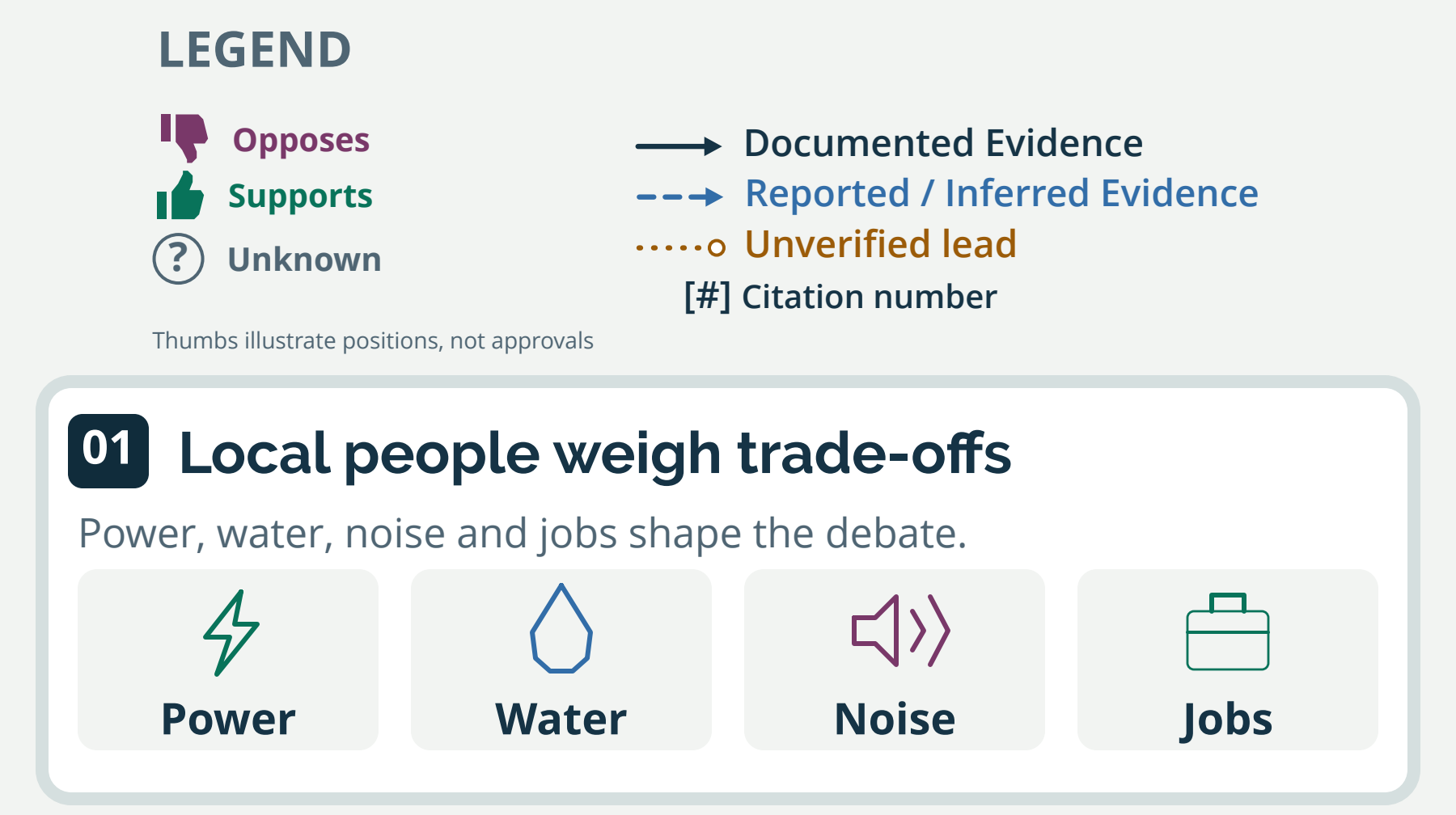
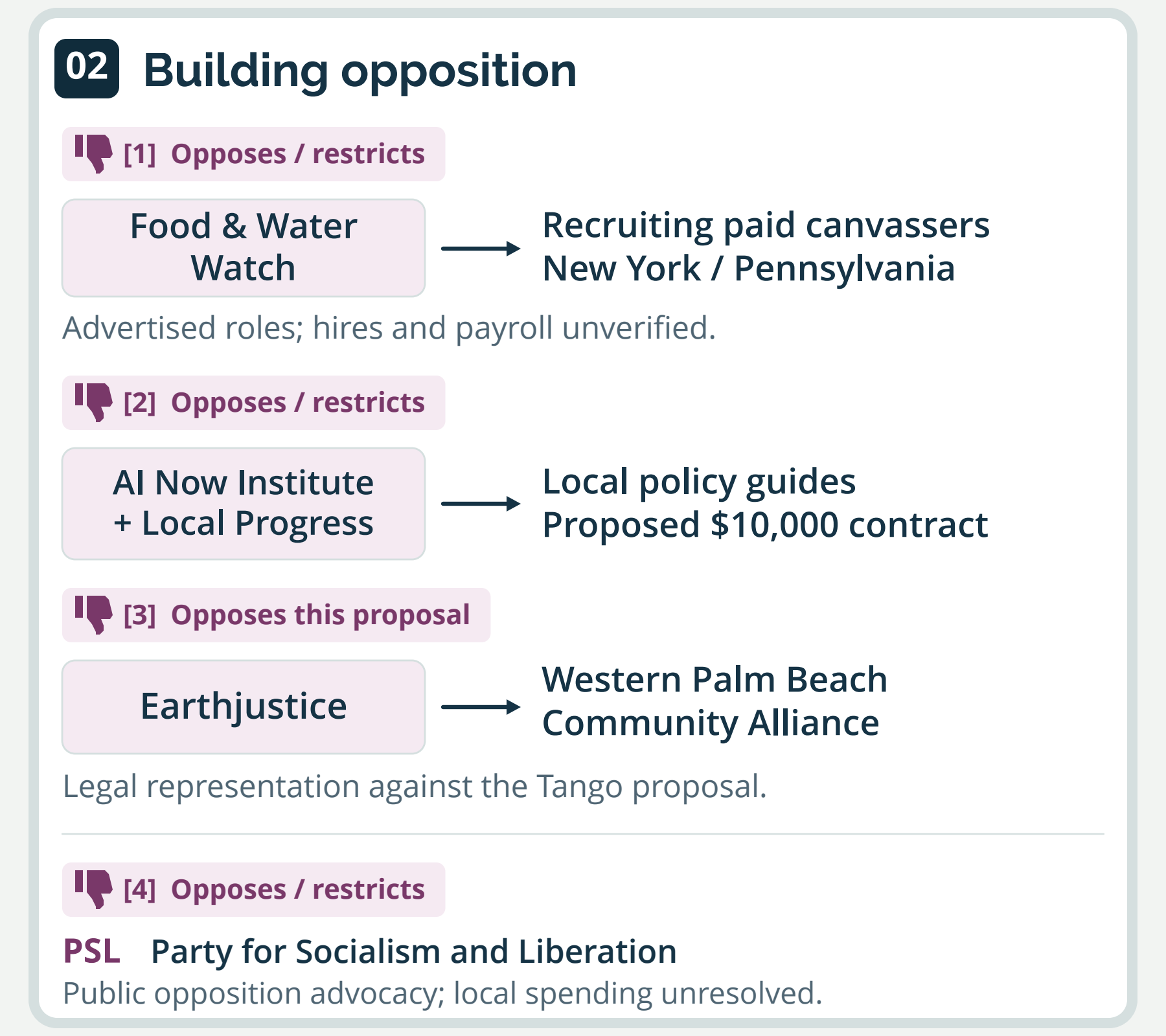
The companion graphic was published October 27, 2026. Its five panels summarize local trade-offs, opposition, support, competing interests at Tango and foreign online influence. The graphic has its own source numbers, separate from the article’s sources below.
Advocacy, recruiting, policy work and legal representation are shown as distinct relationships. View full-size panel. Graphic sources: [1], [2], [3], [4].
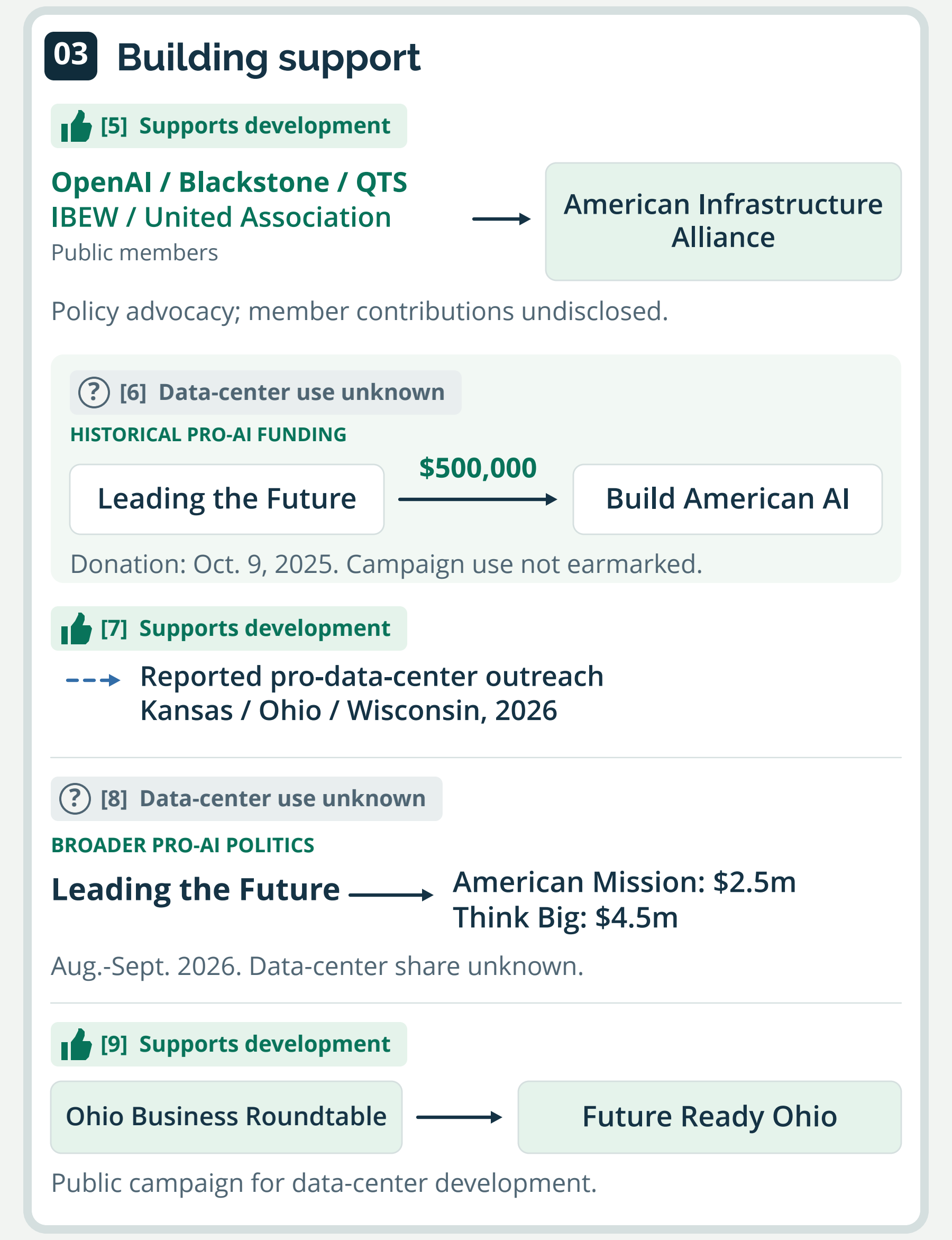
03 Building Support
Public support for development is distinguished from broader pro-AI political funding whose data-center use is unknown. View full-size panel. Graphic sources: [5], [6], [7], [8], [9].
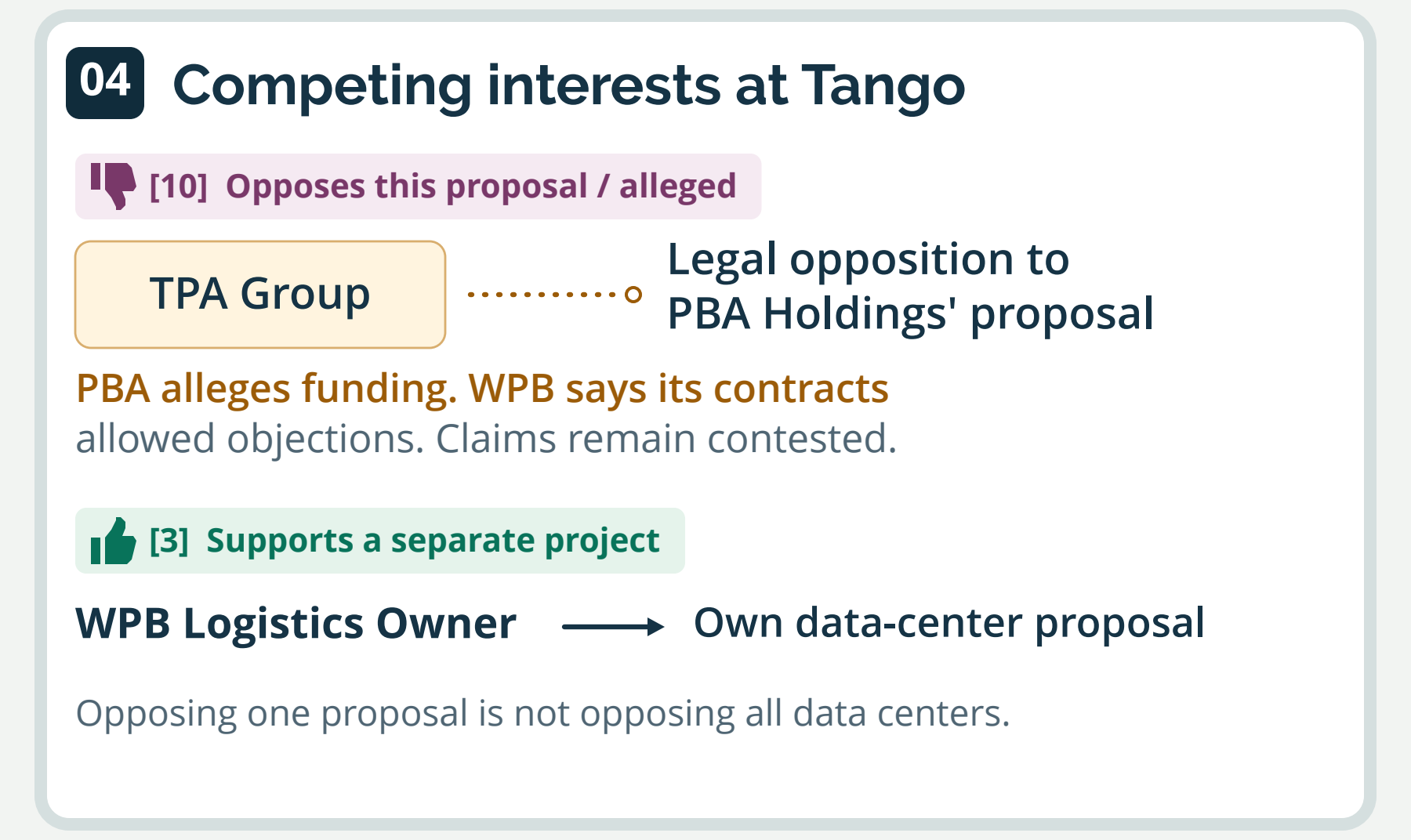
04 Competing Interests at Tango
Contested funding claims are labeled. Opposing one proposal is distinguished from opposing all data centers. View full-size panel. Graphic sources: [3], [10].
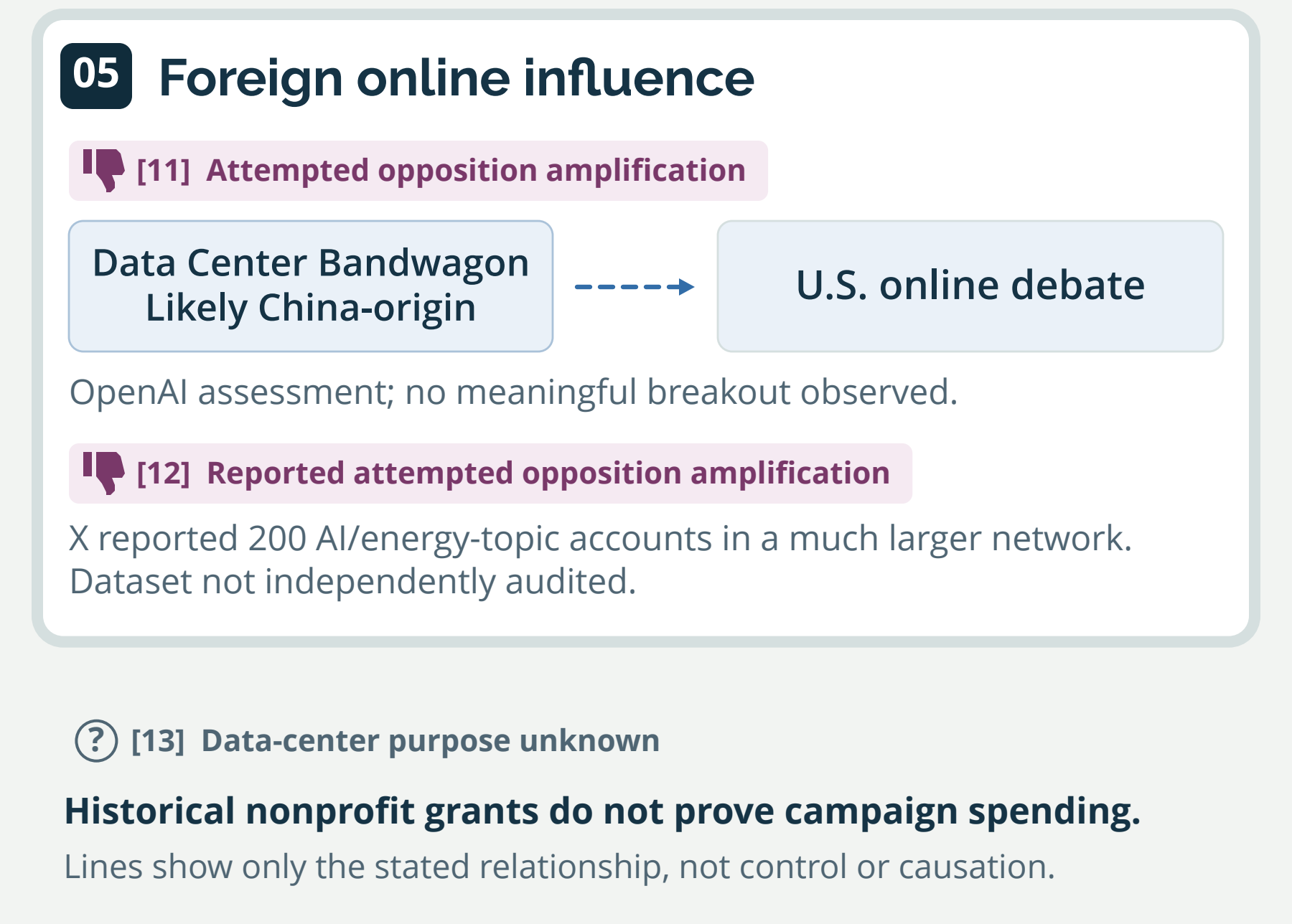
05 Foreign Online Influence
Attempted amplification, observed reach and unresolved campaign funding are qualified separately. Lines show the stated relationship, not control or causation. View full-size panel. Graphic sources: [11], [12], [13].
The beneficial owners and source of funds behind Mutod, limited liability company (LLC) and Likewise Conceptions, limited liability company (LLC), which capitalized People’s Support Foundation.
The advising donor or donors behind donor-advised-fund grants to Justice and Education Fund.
Whether any grant, contractor payment or in-kind support was earmarked for a specific anti-data-center campaign.
The named counterparties behind Justice and Education Fund’s fiscal year 2024 (FY2024) program-service fee pool.
Transaction-level records supporting aggregate reported payments to Maku Group and NewsClick, including potential overlap with already documented contractor payments.
The scope and status of the reported Southern District of New York (SDNY) grand-jury investigation, for which no official United States Department of Justice (DOJ) confirmation or charge was located.
Campaign-specific spending by Party for Socialism and Liberation (PSL) chapters, affiliated media or coalition partners in the remaining local campaigns.
The amount and purpose of the 2021 Department of State award to Southern Poverty Law Center (SPLC) and its relationship to Southern Poverty Law Center (SPLC)’s current no-government-funds statement.
Whether Vote Your Voice funds were used for Poder Latinx’s later data-center-impact advocacy.
Any nonpublic bridge connecting Project Tango or other local campaigns to the mapped China-aligned funding and media ecosystem.
Conclusion
The campaign against hyperscale and artificial intelligence (AI) data centers in the United States is not a single conspiracy and should not be described as one. It is a fast-growing political field made up of homeowners, environmental groups, civil-rights organizations, municipal officials, national policy organizations, political parties, lawyers, grantmakers and media outlets. Many of their concerns are genuine, independently developed and supported by public evidence. 2,9,10,11,12
China is nevertheless present in the story. A People's Republic of China (PRC)-origin covert operation attempted to amplify electricity-cost fears. State media advances a narrative of American dysfunction while promoting China’s infrastructure strategy. China-aligned organizations and individuals overlap with parts of the American activist and media ecosystem. The financial and personnel connections are real enough to justify scrutiny, congressional oversight and continued investigative work. 1,6,7,8,20,21
What the evidence does not yet establish is equally important: no public record reviewed completes the chain from the People's Republic of China (PRC) government to money specifically designated for a local American anti-data-center campaign. Until that bridge is documented, the accurate journalistic conclusion is not that China controls the movement, but that China has attempted to exploit it, benefits strategically from it and may have access to overlapping political and financial networks whose campaign-specific use remains under continued investigation. 1,2,13
Methodology and Fairness Standard
This report was compiled from the version-controlled United States (U.S.) Hyperscale Data Center Influence Network, dataset v0.7.0, containing 212 nodes, 330 relationships, 129 evidence records and 66 documented searches. Sources included federal award records, Internal Revenue Service (IRS) filings and Schedule I/R records, municipal and congressional documents, direct organizational publications, independent reporting and advocacy reports. Official and primary records were weighted above secondary reporting. Advocacy reports were used as leads and labeled accordingly.
A relationship in the network does not imply unlawful conduct, shared ideology, coordination or knowledge of another entity’s activities. Lawful grants, political advocacy, fiscal sponsorship, shared addresses and coalition participation are not evidence of criminality. Incomplete, disputed, anonymously sourced or low-confidence links are identified as under continued investigation rather than presented as fact or eliminated prematurely.
Corrections, Errors and Omissions
Readers, organizations and individuals identified in this report are encouraged to contact us at breakingnews@r30llc.com with corrections, contrary documentation, errors or material omissions. Submissions should identify the disputed statement and provide records or sources sufficient for verification. Verified corrections will be reflected in a subsequent version of the report and source dataset.